Top kits

BBSHD Fat Bike Builds: 100mm and 120mm Shells, Fit and Chainline

Fat bikes and the BBSHD belong together: big tires need big torque, and the motor comes in versions for 100mm and 120mm shells. Match the version to your frame, keep the chain off the tire and gear it low for snow and sand.

Up to date · September 2026
Quick answer

Measure your bottom bracket shell: a 100mm shell needs the 100mm BBSHD, a 120mm shell needs the 120mm version, and neither swaps into the other. Pair it with a low-offset chainring, around 8mm, so the chain stays clear of the tire on a wide rear hub.

  • 100mm shells are the more common fat-bike width.
  • Smaller rings (32–38T) suit snow, sand and 4-inch tires.
  • Check chainstay and tire clearance in the biggest cog.
Fat bike with a 100mm or 120mm shell1 BAFANG BBS-HD 1000W Kit
BAFANG BBS-HD 1000W Kit
Offered in 68, 100 and 120mm versions, so you order the one your shell measures.
  • Complete mid-drive conversion kit
  • 1000W
  • Fits 68/100/120mm bottom brackets
Shop now
Fat build with a smart battery2 BAFANG BBS-HD CAN-bus Kit
BAFANG BBS-HD CAN-bus Kit
The CAN-bus kit fits 100 and 120mm shells and talks to communication-capable batteries.
  • Complete mid-drive conversion kit
  • 1000W · 36V/48V/52V
  • Fits 68–73/100/120mm bottom brackets
Shop now

Matching the 100mm or 120mm version to your frame

A fat-bike conversion starts with the same tape-measure check as any BBSHD build, but the answer has three possible widths instead of one. Pull the cranks, measure the shell face to face, and order the version that matches. A 100mm kit will not clamp in a 120mm shell, and no spacer turns a 68mm kit into a fat-bike one.

  • 100mm shells are the more common fat-bike width, found on many 4-inch and 4.8-inch frames.
  • 120mm shells appear on fewer frames, usually ones built around 190mm or 197mm hubs.
  • Bore still has to fall between 33.5mm and 36mm, which a threaded fat-bike shell normally does.

The fat versions use a longer axle and the matching fixing hardware, so the motor clamps across the wider shell the same way the standard one does. Everything else, from the controller to the display plugs, is the same 1000W, 30A BBSHD.

Several kits come in 68, 100 and 120mm options. Choose the width when you order; a motor's axle length and fixing hardware are not adjustable afterward.

Measure twice on frames with thick shell faces or paint build-up. A shell that reads 101mm is a 100mm shell; one that reads 110mm is something unusual, and worth a question to the frame maker before buying.

The install sequence itself, from fixing plate to lockring, follows the standard install guide.

Specs table

Shell width decides the whole build

Shell widthBBSHD versionTypical rear hubChainring offsetWatch for
68–73mmStandard135, 142 or 148mmDeep, roughly 12–20mmChain angle in the big cogs
100mm100mm versionCommonly 170–197mmLow, about 8mmTire rub in the biggest cogs
120mm120mm versionUsually 190 or 197mmLow, or the kit's ringPedal stance width, stay clearance

Hub pairings are common combinations, not rules; some frames mix a 100mm shell with a 197mm hub. Measure both before choosing a ring.

Keeping the chain off a 4.8-inch tire

Chainline on a fat bike fails in the opposite direction from a trail bike. On a normal frame the stock ring sits too far out; on a fat bike the cassette sits far out on a wide hub, and the danger is a chain that swings inward and drags across the tire in the big cogs.

That is why fat-bike rings carry little offset. A ring dished 20mm inboard, ideal on a hardtail, can pull the chain straight into the tire on a 197mm hub.

  • Big cogs: the chain runs closest to the tire here; check for rub under load, not just in the stand.
  • Small cogs: with a wide hub the angle is usually mild, so a low-offset ring rarely struggles.
  • Tire size: dropping from 4.8-inch to 4-inch tires on the same rims can open up the clearance you need.

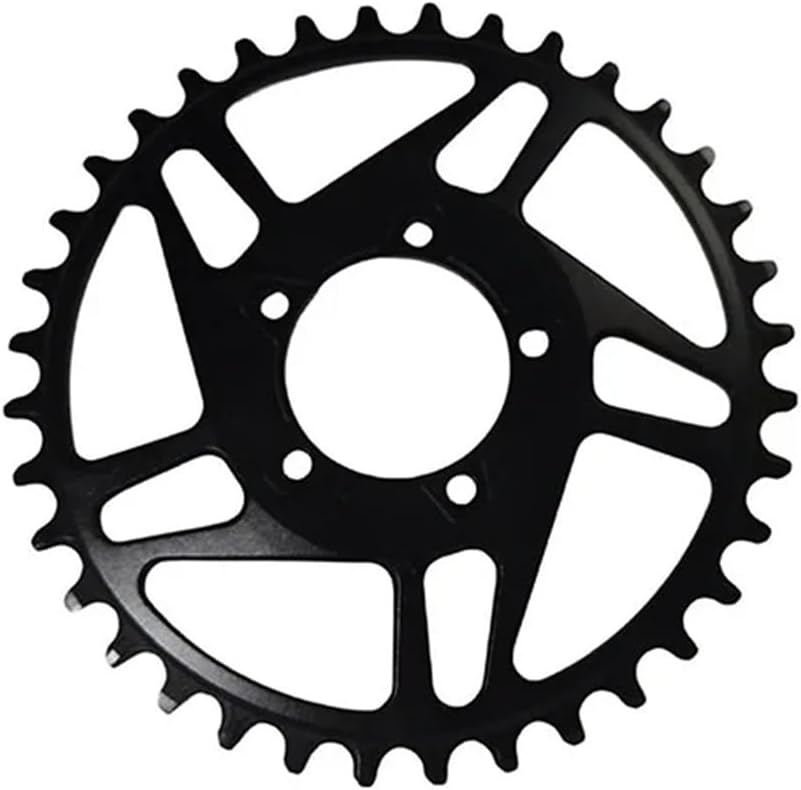
Rings sold for fat-bike BBSHD builds sit around 8mm of offset. The ebsenopower ring and the fat-bike version of the CHAOZHU ring both use that figure, while the mGYDY ring goes to 12mm for frames with a little more room.

If the chain still touches the tire, limit the lowest one or two cogs with the derailleur's limit screw. It costs a climbing gear, but a smaller chainring usually gives it back. Offsets for every frame width sit in the chainring guide.

Kit comparison

Fat-bike kits and rings compared

BAFANG BBS-HD 1000W Kit BAFANG BBS-HD 1000W Kit BAFANG BBS-HD CAN-bus Kit BAFANG BBS-HD CAN-bus Kit ebsenopower BBSHD Chainring ebsenopower BBSHD Chainring Generic BBSHD Chainring Generic BBSHD Chainring mGYDY BBSHD Chainring mGYDY BBSHD Chainring
TypeConversion kitConversion kitChainring & spiderChainring & spiderChainring & spider
Power1000W1000W—1000W—
Voltage—36V/48V/52V———
Bottom bracket68/100/120mm68–73/100/120mm———
Protocol—CAN bus———
Battery—Option———
Shop now Shop now Shop now Shop now Shop now
Tech specs

Spec sheets of the top picks

BAFANG BBS-HD 1000W Kit
Motor
Bafang BBS-HD (model G320), 1000W rated
Other power options
500W and 750W, both BBS02B motors
Torque
Up to 160 N·m at 1000W; 120 N·m at 750W; 100 N·m at 500W
Top speed
Up to 45 km/h (maker figure)
Battery voltage
48V or 52V; 36V on some smaller-motor versions
Battery connector
XT60 male on the motor lead
Battery options
None, 48V 13/16/18.2/20Ah or 52V 20Ah
Bottom bracket width
68–73mm, 100mm or 120mm versions
Bottom bracket inner diameter
33.5–36mm (JIS)
73mm shells
Longer screws needed, not included in every version
Brake compatibility
Disc or V-brake; chain-driven bikes only
Riding modes
Throttle, pedal assist, unassisted cycling
Details →Shop now
BAFANG BBS-HD CAN-bus Kit
Motor
BBS-HD, 1000W; one version also offers BBS02B 750W and 500W
Protocol
CAN bus
Torque
160 N·m at 1000W; 120 N·m at 750W; 100 N·m at 500W
Top speed
Up to 37 mph at 1000W; 34 mph at 750W; 28 mph at 500W (maker figures)
Sensors
Dual Hall sensors
Battery voltage
48V or 52V on the HD; 36V on the smaller options
Battery connector
XT60 male
Battery options
None, or 48V/52V packs from 13Ah to 20Ah
Battery communication
Supported with a communication-capable battery
Bottom bracket width
68–73mm, 100mm or 120mm
Bottom bracket inner diameter
33.5–36mm
Frame limits
Not for carbon frames or coaster brakes
Details →Shop now
ebsenopower BBSHD Chainring
Type
Direct-mount chainring
Motor fit
Bafang BBSHD (M625)
Model name
M625 Chainring
Tooth options
32T, 34T, 36T, 38T
Configuration shown
36T
Offset
About 8 mm
Frame fit
Fat bike compatible
Material
Aluminium alloy
Item weight
200 g
Intended riding
Off-road and trail
In the box
E-bike chainring
Front drivetrain
Single ring, no front derailleur
Details →Shop now

Gearing big tires for snow, sand and cargo

A 26-inch wheel wearing a 4-inch tire has an overall diameter close to a 29er's, and it rolls with far more resistance on soft ground. Put both together and a fat bike asks the motor for heavy current at low speed, exactly the condition that heats a BBSHD.

The fix is gearing, not more power. A smaller chainring keeps the motor turning briskly while the bike crawls through snow or sand.

  • 32–34T for snow, beach sand and loaded touring.
  • 36–38T for mixed trail and gravel on fat tires.
  • 42T and up only for mostly paved fat-bike commuting.

Steel rings last longer at the small end, where chain tension is highest. The steel 32–38T rings are built for 1000W fat bikes for that reason.

On a long soft climb, shift down early and keep your cadence up. A motor lugging at walking pace in a tall gear builds heat far faster than one spinning in a low gear.

Tire pressure matters as much as teeth. Fat tires run at low pressure for float, but on pavement a few extra psi cuts drag and the current draw that comes with it.

A 52V battery helps here too, spinning the motor faster at the same current. Pack choice for heavy, cold riding is its own decision; start with the battery guide.

Pick of the bunch

A ring that keeps the chain off a fat tire

ebsenopower BBSHD Chainring
Best fat-bike chainring ebsenopower BBSHD Chainring

An aluminum ring with about 8mm of offset in 32T, 34T, 36T or 38T, sized for fat bikes on the BBSHD. It keeps the chain out where a wide hub needs it and drops the gearing for soft ground.

Shop now

Clearance around the motor, stays and pedals

Fat frames are wide at the back, which usually helps the motor fit, but they bring their own clearance puzzles. Check them before tightening the lock nuts for the last time.

  • Chainstays: some fat frames flare their stays right beside the shell. Turn the cranks slowly and watch the chainring and motor body.
  • Down tube: rotate the motor up as far as it goes for ground clearance, which matters on rocky trails with a low-hanging motor.
  • Pedal stance: the fat versions are wide across the cranks. Riders with knee or hip trouble should consider this before committing.
  • Kickstand plates: a plate welded behind the shell can block the motor body.
  • Front derailleur mounts: these usually come off, since the BBSHD runs a single ring.

Winter riding adds grit, salt and slush. The controller's end-cap gasket keeps water out, and a fresh controller gasket is worth fitting on an older motor before a snow season.

Route the motor cable and speed-sensor lead above the chainstay, away from the tire. A fat tire throws a lot of snow and mud at anything hanging low.

After the first few rides, re-check the lock nuts and chainring screws. The wide shell gives the motor plenty to clamp against, but temperature swings and vibration loosen hardware on any bike.

Charted

Rear hub widths from trail bike to 5-inch fat

Standard rear hub spacings. Every step wider moves the cassette further out, which is why fat-bike BBSHD builds use rings with little or no inboard offset.

Picking a fat frame that converts cleanly

Fat bikes that make good BBSHD donors share a short list of frame traits; the badge on the down tube matters far less. Look for the combination of a threaded 100mm or 120mm shell, an aluminum or steel frame, and room for a battery.

  • Threaded shell at 100mm or 120mm, with a bore of 33.5–36mm.
  • Aluminum or steel: carbon fat frames face the same clamping concerns as carbon trail frames.
  • Disc brakes strong enough for a heavy bike at speed; four-piston calipers are common upgrades.
  • A front triangle with room for a down-tube battery, or a rack for a rear pack.
  • Rear hub width known in advance, so the chainring offset can be picked to suit.

Many aluminum fat bikes sold as budget trail bikes meet every point and make excellent donors. Frames with press-fit fat shells are rarer and harder to convert.

Battery care changes in winter. Lithium packs lose usable capacity in the cold, so store and charge the battery indoors and fit it just before the ride.

Check the rear hub width stamped on the frame or measured at the dropouts. It decides chainring offset as much as the shell width does.

For donor-bike choices beyond fat bikes, the frame guide sorts mountain, road and cargo donors.

Build Q&A

Builders ask

Does the BBSHD fit a fat bike?

Yes. It comes in 100mm and 120mm versions for fat-bike shells, alongside the standard 68–73mm version.

How do I know if I need the BBSHD 100mm or 120mm?

Remove the cranks and measure the bottom bracket shell face to face. Order the version that matches; they are not interchangeable.

Can a BBSHD 120mm fit a 100mm shell?

No. The fixing hardware clamps across the shell width, so the version must match the shell.

What chainring suits a BBSHD fat bike?

A low-offset ring, around 8mm, in 32–38T. Deep-offset rings made for 68–73mm frames can push the chain into the tire.

Why does my chain rub the tire on a fat bike?

The chain angles inward in the big cogs on a wide hub. A lower-offset ring, a narrower tire or a limit screw set to skip the biggest cog fixes it.

Keep building

More BBSHD guides

Garage shelf

Kits and rings for a fat-tire BBSHD