- Complete mid-drive conversion kit
- 1000W
- Fits 68/100/120mm bottom brackets
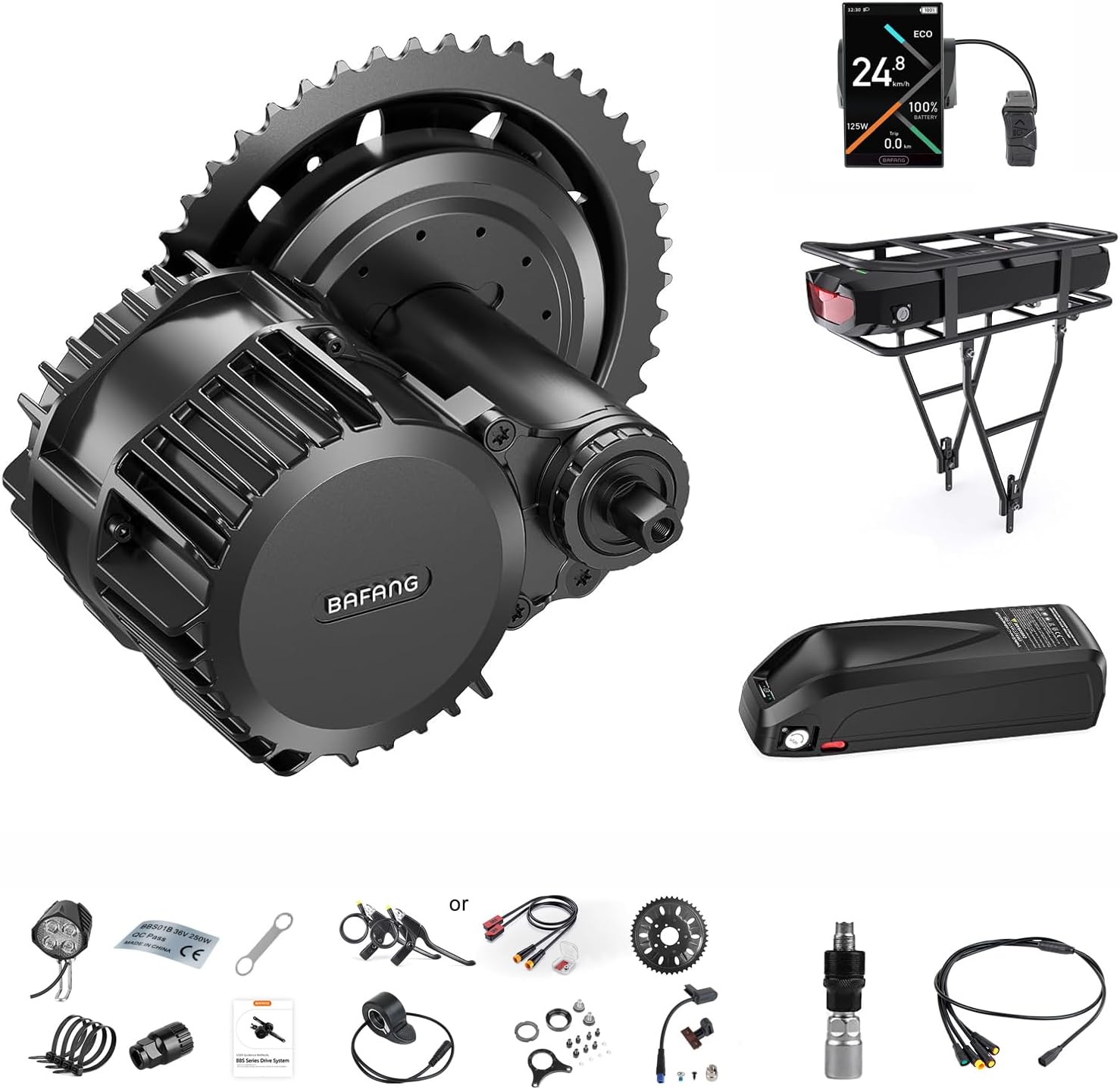
The CAN-bus BBS-HD keeps the heavy-duty 1000W motor and swaps the old UART wiring for Bafang's newer protocol. You change settings from a programmable display or the Bafang Go app, the motor can read a smart battery, and a taillight lead with brake-light function comes in the box.
CAN bus is a wiring protocol borrowed from cars: every part on the bike shares one data line and identifies itself on it. On the BBS-HD that means the motor, display and a compatible battery exchange real data instead of the display guessing charge from voltage. With a communication-capable pack, the screen shows battery percentage and status rather than a rough bar graph.
The rest of the kit follows from that. Bafang fits upgraded dual Hall sensors to the motor for steadier current output, and adds a dedicated taillight cable with brake-light function, so the rear lamp flashes brighter when you pull a lever.
Three versions cover different starting points. The broadest one offers every power level and voltage with an LCD display and an optional pack. The other two are HD-only 1000W kits, one bundled with a battery and one sold as a motor kit that takes any 48V or 52V pack with an XT60 connector. The 36V choice on the broadest version belongs to the smaller BBS02B motors; the HD itself runs on 48V or 52V.
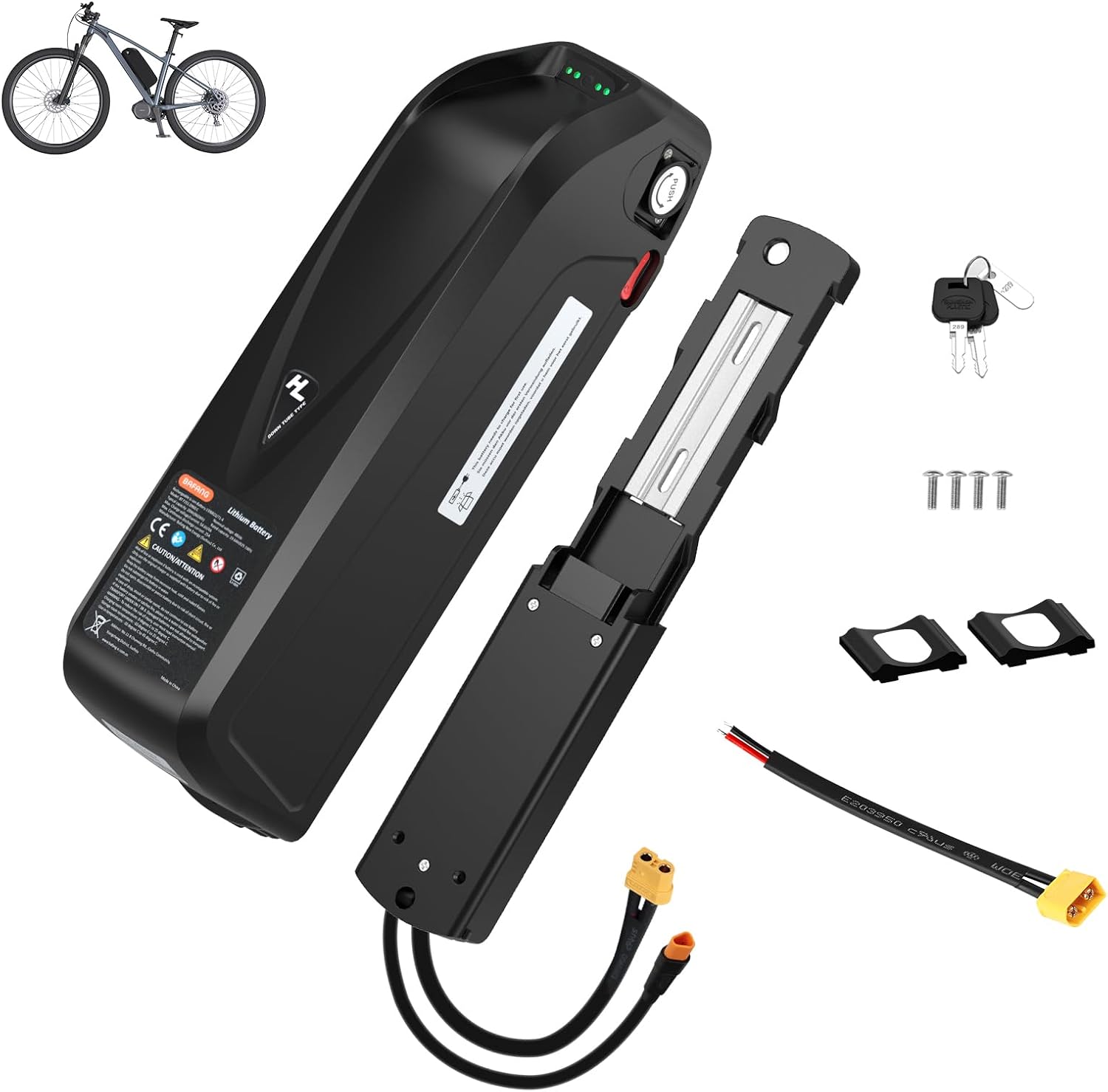
Builders who plan to use a smart pack should look at the Bafang 48V 20Ah battery, which carries the communication function this kit can read.
| Spec | Value |
|---|---|
| Motor | BBS-HD, 1000W; one version also offers BBS02B 750W and 500W |
| Protocol | CAN bus |
| Torque | 160 N·m at 1000W; 120 N·m at 750W; 100 N·m at 500W |
| Top speed | Up to 37 mph at 1000W; 34 mph at 750W; 28 mph at 500W (maker figures) |
| Sensors | Dual Hall sensors |
| Battery voltage | 48V or 52V on the HD; 36V on the smaller options |
| Battery connector | XT60 male |
| Battery options | None, or 48V/52V packs from 13Ah to 20Ah |
| Battery communication | Supported with a communication-capable battery |
| Bottom bracket width | 68–73mm, 100mm or 120mm |
| Bottom bracket inner diameter | 33.5–36mm |
| Frame limits | Not for carbon frames or coaster brakes |
| Programmable displays | DPC080, DP C010, VD04, EKD01 (on screen or app) |
| Non-programmable displays | VD03, VD618, VD18MT (USB cable and computer) |
| In the box | Motor, sprocket, cranks, throttle, brake sensor, speed sensor, cables, installation tools |
| Lighting | Dedicated taillight cable with brake-light function |
| Warranty | 365 days repair or replace |
On a UART BBS-HD, every settings change means a laptop, a USB cable and a configuration tool. The CAN version gives you a shorter path if you pick the right display. Programmable CAN displays such as the DPC080, DP C010, VD04 and EKD01 adjust motor parameters on the screen itself or through the Bafang Go app on a phone, with no cable at all.
Cheaper CAN displays such as the VD03, VD618 and VD18MT show your data but cannot change settings. With one of those, you add a USB programming cable and adjust parameters from a computer, much like the UART routine.
| Display | Programmable | How you change settings |
|---|---|---|
| DPC080, DP C010 | Yes | On screen or Bafang Go app |
| VD04, EKD01 | Yes | On screen or Bafang Go app |
| VD03, VD618, VD18MT | No | USB programming cable and a computer |
The practical upshot shows up at the trailhead. You can soften the launch before a technical climb, or raise the top assist level for a long road stretch, without carrying anything but a phone. A cargo rider can dial the throttle down for a child seat on Monday and back up for a trail day on Saturday.
The settings themselves, current limit, assist steps and launch, work the same way on both protocols. Programming the BBSHD explains what each one does to heat and range, and the display guide compares screens.
The protocol change reaches every electrical part on the bike. UART displays such as the DPC18 5-pin version, the C961 and the common 500C, 1T4 harnesses, UART light kits and UART controllers all speak the older language, and none of them work on a CAN motor even when a plug looks similar. Order electrical spares with CAN in the name, and pick displays from Bafang's CAN range.
Battery choice is flexible. The motor runs on standard 48V or 52V packs as well as Bafang's own, as long as the connector is XT60 and the BMS handles the motor's full current. You only lose the percentage readout and smart protection when the pack cannot talk to the motor.
Mechanical fit follows the same rules as any HD. Frames must have a threaded shell of the right width, no carbon and no coaster brake; measure and torque by the install guide, and check discharge ratings in the battery guide.
Bafang quotes up to 37 mph for the 1000W setting, 34 mph at 750W and 28 mph at 500W. Real speeds depend on voltage, gearing, tire size and rider weight, and on how the motor is programmed. Either way, the 1000W setting sits well past what US e-bike laws allow on public roads.
Most states use the three-class system, which caps motors at 750W and assisted speed at 20 or 28 mph. A 1000W BBS-HD falls outside it in most states, so plan the build for private land or off-road areas that allow motors unless your state rules differ.
The protocol changes nothing about heat. A long climb in a high gear still soaks the motor, so the usual HD habits apply: shift down early, keep cadence up and lean on assist rather than throttle on the steepest pitches.
Pick this kit or the classic UART one by how you like to work on the bike.
A rider starting from scratch, with no old parts to reuse, gains the most from CAN. Someone rebuilding a second HD from a box of spares will be happier with the standard 1000W kit in its UART form, where every spare already in the drawer still fits.
The BBS02 vs BBSHD comparison helps if you are weighing the 750W option inside this kit.
Yes, with a programmable display such as the DPC080, DP C010, VD04 or EKD01, which change settings on screen or through the Bafang Go app. Basic displays need a USB programming cable.
No. UART and CAN parts do not work together, even when a plug looks similar. Use CAN displays and the harness supplied with the kit.
No. Any 48V or 52V pack with an XT60 connector and a BMS that handles the motor's current will run it; a communication-capable pack adds exact charge readouts.
It is the same 1000W heavy-duty motor class with the same shell widths, fitted with dual Hall sensors and CAN electronics.
In most states it falls outside the three e-bike classes, which cap motors at 750W, so it is generally limited to private land or off-road areas that allow motors.