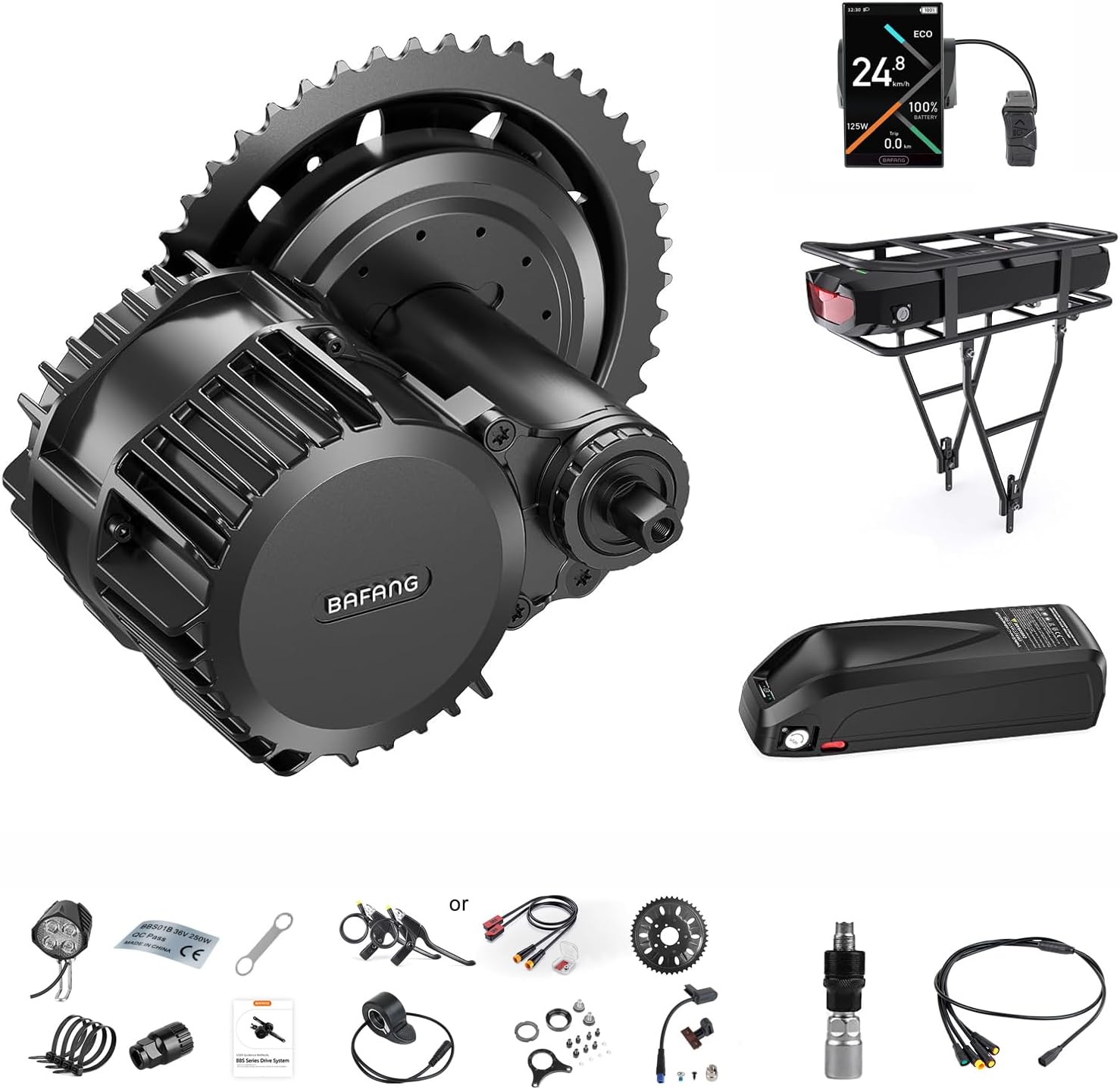
Top kits
BBSHD / BBS02B battery · 48V 20Ah · CAN communication

BAFANG 48V 20Ah E-bike Battery

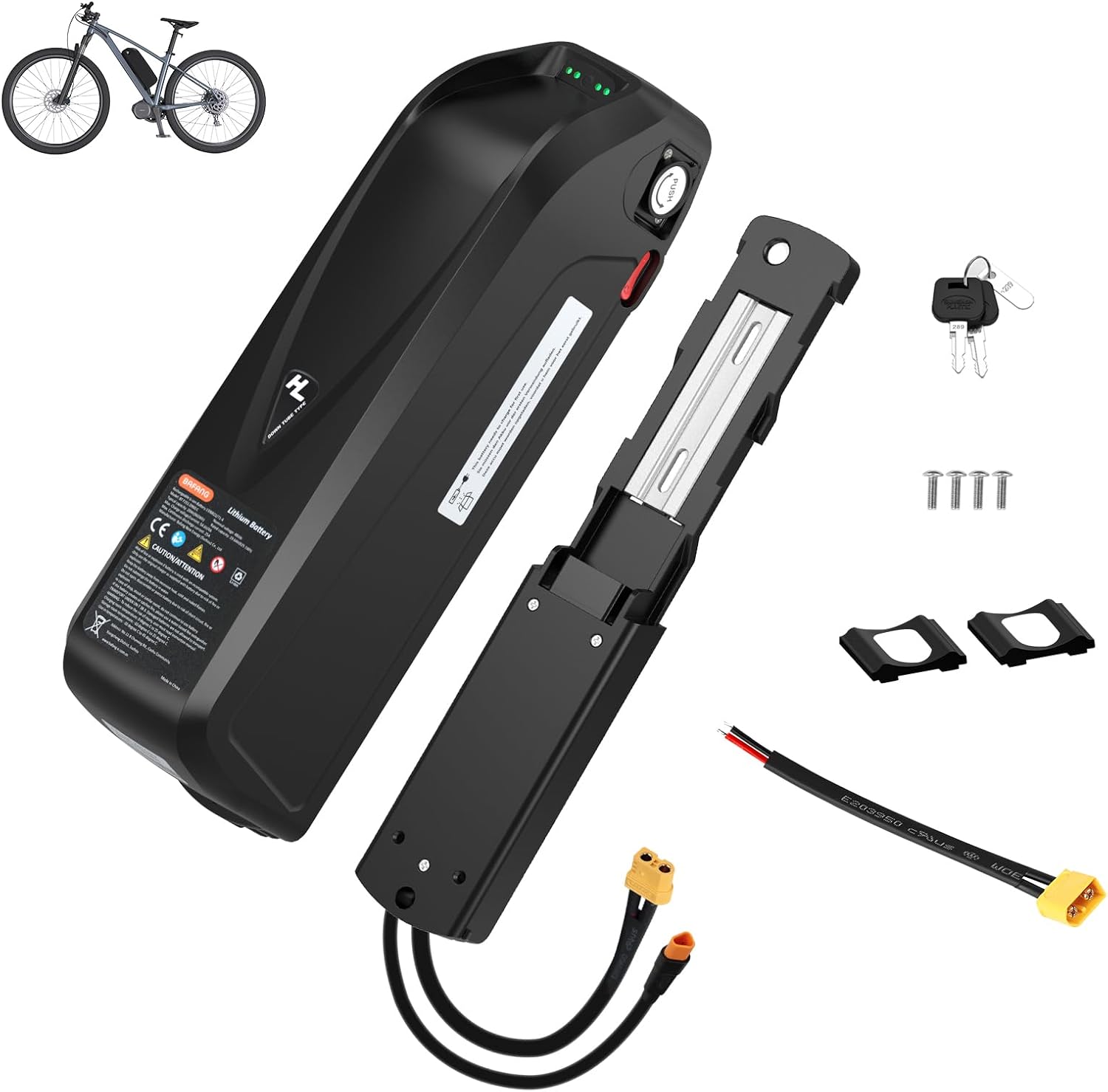
A 48V 20Ah pack from Bafang itself, built to talk to Bafang's CAN-bus mid-drives so the display shows a real percentage instead of five vague bars. It carries roughly 960Wh, a 30A BMS and an XT60 output that plugs straight into a current BBSHD kit.

  • Voltage48V nominal
  • Capacity20Ah, about 960Wh
  • BMS30A, with over-charge, over-discharge, over-current, short and temperature protection
  • CommunicationCAN bus data to Bafang displays
  • OutputXT60 cable
  • In the boxPack, mounting plate, two keys, XT60 lead, 100–240V charger
Made for
  • BBSHD and BBS02B builders on Bafang's CAN-bus system who want true battery percentage on the display
  • Riders who want a long-range pack from the same maker as the motor
  • Commuters and trail riders whose rides run past two hours of steady assist
Pass if
  • Riders chasing the extra top-end punch of a 52V pack
  • Older UART BBSHD kits, where the communication feature has nothing to talk to
  • Short frames with no room on the downtube for a 20Ah case
Shop now

A fuel gauge that reads real percent on a long climb

Most e-bike packs tell the display nothing. The controller guesses the charge from voltage, and voltage sags every time you lean on the throttle, so the bars drop on a climb and bounce back on the flat. This BAFANG 48V pack carries a CAN-bus communication line that reports its own state to the display: a percentage, the true voltage and a system status.

That matters most on the rides where a BBSHD earns its keep. Picture a 900-foot fire-road climb at the end of a two-hour loop. With a voltage-guessing gauge, the last bar starts flashing halfway up because the motor is pulling hard. With a pack that counts what went in and out, the display tells you there is 22% left, and you can decide whether to stay in PAS 5 or drop to PAS 2 and spin.

  • Percentage, not bars: the pack reports its own charge level to a Bafang CAN display.
  • Voltage and status: you see the real number and any BMS warning instead of a silent cutout.
  • Same ecosystem: Bafang tunes it for its BBS01, BBS02 and BBS-HD mid-drives.

The catch is the word CAN. The data link only works when the motor and display speak Bafang's CAN protocol, as the newer BBS-HD CAN-bus kit does. On an older UART BBSHD the pack still runs the motor through its XT60 lead, but the display falls back to its usual voltage estimate.

Check your system first. A UART kit uses the 5-pin display plug and the 1T4 harness; a CAN kit uses Bafang's newer connectors and advertises battery communication. Only the second gets the smart-gauge benefit.
Tech specs

By the numbers

SpecValue
BrandBAFANG
Nominal voltage48V
Capacity20Ah
Energy (48V × 20Ah)About 960Wh
CellsLithium-ion, described as automotive-grade
Battery management30A BMS
ProtectionsOver-charge, over-discharge, over-current, short circuit, extreme temperature
CommunicationCAN bus, battery percentage, voltage and status on Bafang displays
Motor compatibilityBAFANG BBS01, BBS02 and BBS-HD mid-drives (0–1500W)
Output connectorXT60 output cable
MountingUniversal mounting plate
SecurityLock with two keys
Charger100–240V smart charger
Charge timeAbout 6–7 hours from empty
In the boxBattery, mounting plate, two keys, XT60 output cable, charger
Warranty30 days return, 365 days repair or replace

Twenty amp-hours for cargo days and heat-soaked hills

Twenty amp-hours at 48V works out to about 960 watt-hours of stored energy. How far that carries you depends almost entirely on how you ride, and a BBSHD gives you a lot of ways to burn it quickly. Throttle-only riding at full current on a loaded cargo bike might take several times the energy per mile of light pedal assist on a paved path.

A rough way to think about it: a BBSHD rider who pedals along in low-to-middle assist often lands somewhere around 15–25 watt-hours per mile, while heavy throttle use, big tires, cargo and steep grades push that past 30. On 960Wh, that spreads from roughly 30 miles on a hard day to 60 or more on a gentle one. Treat those as hedged planning numbers, not promises.

Riding styleTypical drawRough range on 960Wh
Light PAS, paved commute15–20 Wh/mile48–64 miles
Mixed PAS and throttle, rolling hills20–25 Wh/mile38–48 miles
Cargo, fat tires or steep trail climbs30+ Wh/mileUnder 32 miles

Capacity also helps with heat. A small pack drawn hard at 30A sags more, runs warmer and ages faster. A 20Ah pack spreads the same current across more cells, so each cell works less. The 30A BMS sits right at the stock BBSHD controller's current limit, which keeps a full-power climb inside the pack's protection window.

  • Towing a kid trailer up a long grade? This capacity keeps voltage steadier on the pull.
  • Long heat-soaked summer climbs at low speed are where a bigger pack earns its weight.
Range check

Its spot in the range

BBSHD mid-drive kit models by type, September 2026. Highlighted: BAFANG E-bike Battery.

Bolting a 20Ah case to the downtube and plugging in the XT60

Everything to mount and run the pack comes in the box: the battery, a universal mounting plate, two keys for the lock, an XT60 output cable and a 100–240V smart charger. The XT60 is the same connector current Bafang BBSHD kits put on the motor's power lead, so there is no soldering between pack and motor on those builds.

The fit question is physical before it is electrical. A 20Ah case is long, and the mounting plate needs a flat run of downtube with bottle bosses or clamps. Full-suspension frames, small hardtails and step-throughs with curved tubes are where it gets tight. Measure before you order.

  1. Measure the downtube from the head-tube weld to the front derailleur mount or the motor, and compare it with the pack's length plus a little clearance for sliding the pack off the plate.
  2. Check the bosses. Two bottle-cage bosses are the usual anchor. If the frame has only one, plan hose clamps or a boss adapter.
  3. Route the XT60 lead along the downtube to the BBSHD so it clears the crank arm and does not get pinched by the steering at full lock.
  4. Charge fully once before the first ride. The charger takes about 6–7 hours from empty.

If your motor has a different power plug, such as an Anderson connector on an older build, you need an adapter or a new plug on one side. Keep the polarity right: red to red, black to black, checked with a meter before the first connection. Cable routing around the motor is drawn out in the BBSHD install walkthrough.

Other options

Also worth a ride

Build it on CAN from scratch1 BAFANG BBS-HD CAN-bus Kit
BAFANG BBS-HD CAN-bus Kit
The BAFANG BBS-HD CAN-bus kit supports battery communication and offers its own 48V and 52V pack options, so motor, display and battery come matched.
  • Complete mid-drive conversion kit
  • 1000W · 36V/48V/52V
  • Fits 68–73/100/120mm bottom brackets
Shop now
Motor and pack in one box2 BAFANG BBS-HD Kit with Battery
BAFANG BBS-HD Kit with Battery
The BAFANG BBS-HD kit with battery ships the 1000W motor with a 48V or 52V battery option, a simpler route for a first conversion.
  • Complete mid-drive conversion kit
  • 1000W · 48V/52V
  • Battery option available
Shop now
52V for more top-end3 BAFANG BBS-HD Kit with Battery
BAFANG BBS-HD Kit with Battery
This BBSHD 68mm kit pairs the motor with a 52V 20Ah pack, trading the CAN gauge for higher voltage under load.
  • Complete mid-drive conversion kit
  • 1000W · 48V/52V
  • Battery option available
Shop now

Choosing 48V over 52V for a BBSHD build

The BBSHD runs happily on either 48V or 52V packs, and the choice changes the feel of the bike more than the spec sheet suggests. A 52V pack sits higher at full charge and sags less under load, so the motor spins a little faster and pulls a little harder on top. A 48V pack gives up some of that top-end snap in exchange for broader compatibility and a gentler load on components.

This Bafang pack is the 48V route. It matches what Bafang lists as the system voltage for its BBS-HD kits and the stock 48V controller. Whichever voltage you pick, the rule holds: match the pack to what the controller and display are set up for. A 48V display on a 52V pack will read the battery wrong, and the low-voltage cutoff may sit in the wrong place.

  • Pick this 48V pack if you run a Bafang CAN-bus BBSHD and want the smart gauge, or you prefer staying at the voltage Bafang specifies.
  • Look at 52V if you ride mostly throttle on flat ground and want the extra speed, and your controller and display are set for it.
  • Stay at 48V on a UART build whose display was never reprogrammed for 52V.

For a kit-plus-battery route, the BBS-HD kit with battery bundles motor and pack in one box. The full voltage argument, including why 72V needs a different controller, lives in the 48V vs 52V battery guide. Before paying for a big pack, confirm your controller version, measure the frame, and decide whether the CAN data link is something your system can use.

Build Q&A

Fitment Q&A

Will this battery work on my older UART BBSHD?

The 48V output will run a UART BBSHD through the XT60 lead if your connectors match. The CAN-bus battery data will not reach a UART display, so you get the usual voltage-based gauge.

How long does a full charge take?

About 6–7 hours from empty with the included 100–240V charger. A partial top-up after a normal ride takes less.

Is 30A of BMS enough for a BBSHD?

The stock BBSHD controller limits current to about 30A, so the BMS matches it. If you plan a higher-current aftermarket controller, you need a pack with more BMS headroom.

How far will 20Ah take me?

At 48V the pack stores roughly 960Wh. Light pedal assist can stretch that past 50 miles, while throttle-heavy cargo or steep trail riding can bring it under 30.

What mounting hardware comes with it?

A universal mounting plate and two keys for the lock. Most frames mount it on the downtube bottle bosses.