
FREERDNG Chainring Spider Adapter
130BCD spider with a 50T–60T narrow-wide ring in 7075-T6 alloy, ready to bolt on.
- Chainring for the BBSHD

A stainless-steel spider that converts the Bafang BBSHD output to the 130BCD five-bolt pattern. It ships with five chainring bolts and a spacer washer, and leaves the choice of ring entirely to you.
The IQ Labs part does one job: it turns the BBSHD's splined output into a standard 130BCD mount. Once it is on, the world of five-bolt road and single-speed rings opens up, and you are no longer limited to rings made only for Bafang motors.
The spider is stainless steel, which is harder than the aluminium most adapters use. That matters on a motor that puts out far more torque than any rider's legs. Bolt holes in soft alloy spiders can ovalise over time under repeated hard launches; steel resists that wear better and adds a few grams.
At 4.8 oz, the penalty is small. The kit is complete for mounting, too: five chainring bolts to hold the ring and one spacer washer for chainline tuning. The ring itself is the one thing missing, and that is the point.
It also keeps a build future-proof. If you move from a flat commute to a hilly one, or from a 48V pack to 52V, the ring changes while the spider stays. Rings from different makers bolt to the same five arms, so wear parts stay easy to find years later.
That flexibility suits the builder who already knows which ring they want. If you do not, a complete set like FREERDNG's or alltoo's saves a step.
| Spec | Value |
|---|---|
| Type | Chainring spider adapter (ring not included) |
| Motor fit | Bafang BBSHD mid-drive only |
| Does not fit | Bafang BBS02 |
| Mounting standard | 130BCD |
| Bolt pattern | 5-bolt (130BCD standard) |
| Smallest ring on 130BCD | About 38T–39T (bolt-circle limit) |
| Material | Stainless steel |
| Colour | Black |
| Item weight | 4.8 oz |
| Chainring bolts | 5 included |
| Spacer | 1 spacer washer included |
| Model | IQ LABS MTB 001 |
| Warranty | 1 year |
| Package size | 12 × 6 × 1 in |
| Shipping weight | 8 oz |
IQ Labs states it plainly: the spider fits the BBSHD and will not fit the BBS02. The two motors look alike from a distance, but their output splines differ in size, so a spider made for one physically cannot seat on the other.
Know which motor sits in your bottom bracket first. The motor casing carries a label with the model name, and there are physical tells as well. The BBSHD is the larger, heavier unit rated at 1000W, while the BBS02 is the 500W–750W unit with a smaller housing.
Heat handling, gearing and the rest of the split between the two motors sit in the BBS02 vs BBSHD comparison. If the motor turns out to be a BBS02, look for a 104BCD adapter that names that motor specifically.
One more check: the spider replaces the stock ring entirely. The old ring does not bolt onto it, so budget for a 130BCD ring in the same order if you do not already own one.
Chainline is where spider builds go right or wrong. The goal is simple: the ring's tooth plane should line up with the middle of the cassette, so the chain runs straight in the gears you use most.
The BBSHD's stock ring sits well outboard, which is fine on wide rear ends and awkward on narrow ones. A flat 130BCD spider changes where the ring sits relative to the stock position, and the included spacer washer lets you nudge it by a small amount. Where you land depends on your frame, your ring's own offset and the rear spacing.
| Rear spacing | Typical target chainline |
|---|---|
| 135 mm / 142 mm | About 50 mm |
| 148 mm Boost | About 52–55 mm |
| 170–177 mm fat bike | Around 66–70 mm |
| 190–197 mm fat bike | Around 72–80 mm |
Those are ballpark figures; cassette position varies by hub. Measure from the frame's centreline to the middle of the ring, then compare with the middle cog.
Get it wrong and the symptoms are easy to hear. A chain that grinds on the largest cogs, skips under throttle or rubs the ring's teeth sideways is running at too sharp an angle. With a single ring and a wide cassette, a small error shows up at both ends of the range, so aim for the middle.
Fat bikes are the hardest case. Why 100 mm and 120 mm bottom brackets shove the chainline outboard is in the BBSHD fat bike guide.
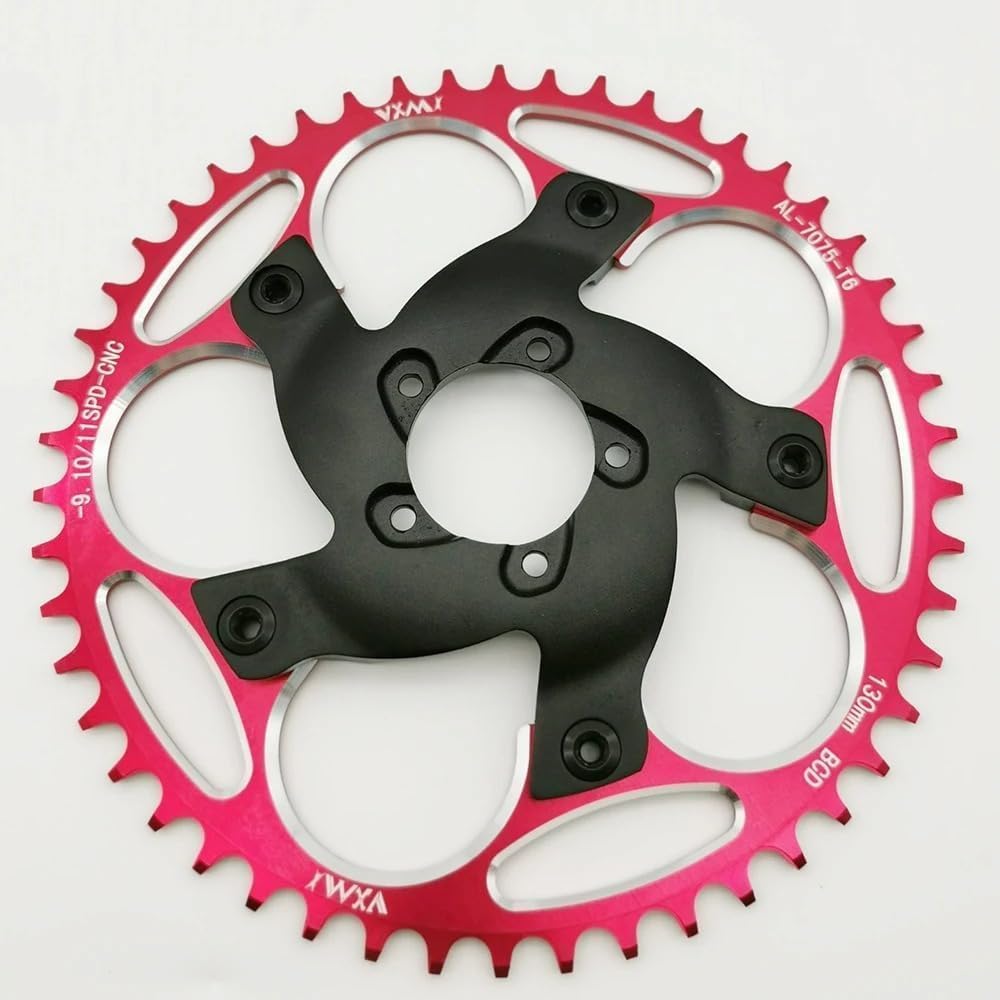

The spider sets a floor on ring size. On a 130 mm bolt circle, the smallest ring that fits is around 38T or 39T, because a smaller ring would have its teeth inside the bolt heads.
That rules the IQ Labs spider out for steep trail and cargo builds, where 32T–38T rings keep the motor spinning and cool. It points the part squarely at road, gravel and fast commuter bikes. Within that range, choose by the speed you cruise at, not the speed you might hit downhill.
Narrow-wide profile is worth paying attention to. A 1x drivetrain has no front derailleur to keep the chain on, so a narrow-wide ring does that work. A plain road ring with shift ramps will drop chains over rough ground.
Tooth count also changes chain length. Add roughly one link pair for every four teeth you go up from the stock 46T, or remove one for every four you go down, then confirm with your derailleur maker's big-big method.
Installation follows the usual spider routine: crank off with a puller, stock ring off, spider on with threadlocker, ring on with the five included bolts in a star pattern. The chainring guide compares this route with direct-mount offset rings, which skip the spider entirely.
No. The box holds the spider, five chainring bolts and a spacer washer; the 130BCD ring is a separate purchase.
No. IQ Labs states it fits the BBSHD only, and the BBS02 output spline is a different size.
About 38T–39T, the practical limit of a 130 mm bolt circle. For smaller climbing rings, use a 104BCD adapter or a direct-mount ring.
Steel is harder, so bolt holes and splines resist wear under the motor's torque, for a small weight penalty.