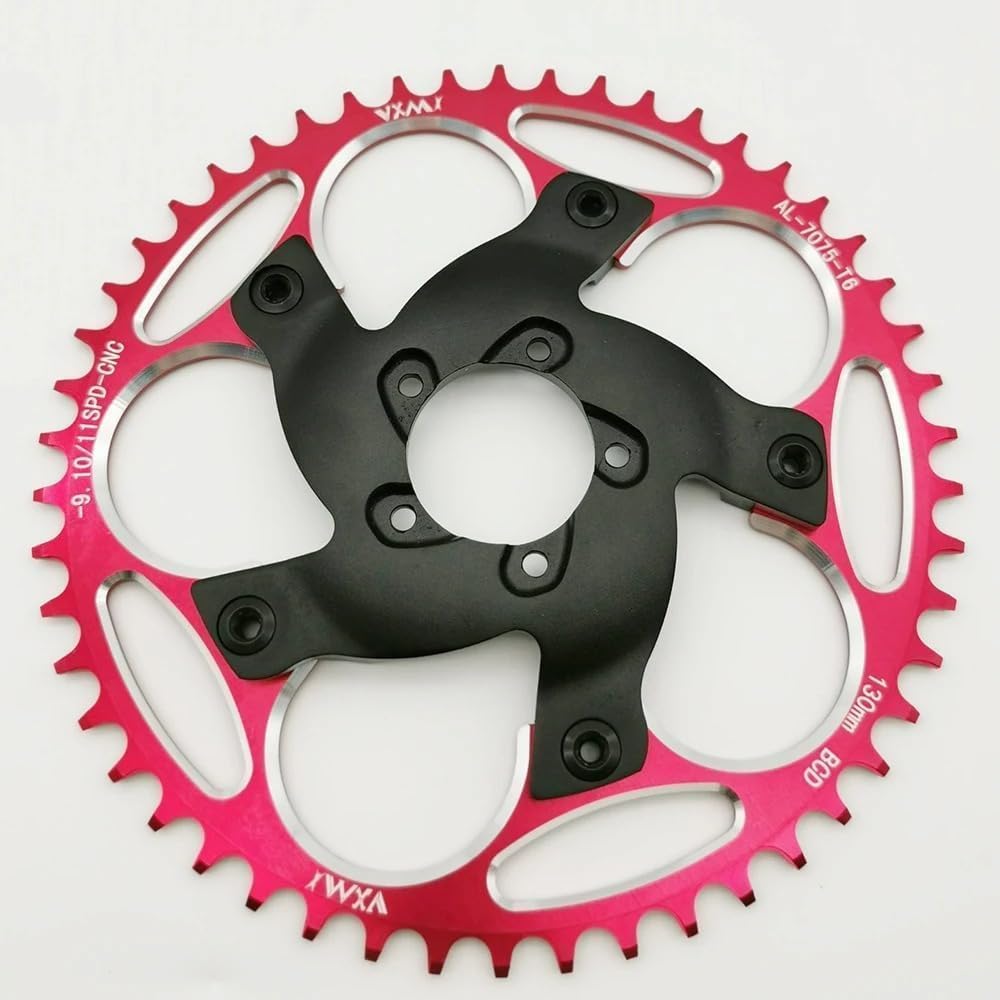
alltoo Chainring Spider Adapter
Another 130BCD spider-and-ring set for the BBSHD, offered in red or black up to 60T.
- Chainring for the BBSHD
- 39/50/52/54T options

A 130BCD spider-and-ring set for the Bafang BBSHD with tooth counts from 50T up to 60T. It exists for one kind of build: long, fast, mostly flat miles where the stock ring runs out of gear.
The stock BBSHD ring is a compromise gear, and on a long flat road with a tailwind it runs out. Once the motor hits its crank-speed ceiling, the only way to go faster is a taller gear, and the FREERDNG set supplies it with rings from 50T up to 60T on a 130BCD spider.
The spider is the part that matters. It slides onto the BBSHD output and presents a standard five-bolt 130BCD face, the same pattern road cranks have used for decades. The ring on it is CNC machined from 7075-T6 alloy, the harder of the two common aluminium grades, with a 6061 alloy part making up the rest of the set.
Gear speed is simple arithmetic: cadence times gear ratio times wheel circumference. The figures assume a steady 90 rpm on an 11T cog, which is a comfortable spin for most riders.
| Ring | 2.1 m wheel (27.5 × 2.4) | 2.3 m wheel (29er or fat) |
|---|---|---|
| 46T (stock size) | 29.5 mph | 32.3 mph |
| 50T | 32.0 mph | 35.1 mph |
| 52T | 33.3 mph | 36.5 mph |
| 56T | 35.9 mph | 39.3 mph |
| 60T | 38.4 mph | 42.1 mph |
Those are the speeds your legs and the motor share at that cadence. Whether the motor can hold them depends on pack voltage, wind, rider weight and local speed rules, so treat the upper rows as ceilings, not promises.
| Spec | Value |
|---|---|
| Type | Chainring set with spider for the BBSHD |
| Motor fit | Bafang BBSHD mid-drive |
| Mounting standard | 130BCD |
| Bolt pattern | 5-bolt (130BCD standard) |
| Tooth options | 50T to 60T |
| Configuration shown | 52T |
| Tooth profile | Alternating narrow-wide |
| Alloys named | 7075-T6 and 6061 aluminium |
| Manufacture | CNC monolithic machining |
| Item weight | 300 g |
| Colour | Black |
| Front drivetrain | Single ring, no front derailleur |
| Package size | 7 × 7 × 1.5 in |
| Shipping weight | 12.32 oz |
| Support | Return and exchange service |
Every tooth you add at the front makes the motor work harder at low road speed. On a steep grade a 52T ring forces the BBSHD to turn slowly under heavy current, and slow, loaded motors turn current into heat instead of speed.
This is the trade the FREERDNG set asks you to make. On the flat, a big ring lets the motor run near its efficient speed while the bike moves fast. On a climb, it pulls crank cadence down, and the rider feels the bike bog while the motor casing warms.
Heat soak builds quietly. A 20-minute climb on a big ring can push the controller into its thermal cut-back, where power drops until things cool. The nylon primary gear inside the drive also sees its highest loads in exactly this situation, low speed and high torque, which is why it tends to wear on heavy, tall-geared builds. Match the symptoms against the nylon gear and clutch guide.
For a rider on flat roads, none of this bites. The set suits prairie commutes, coastal paths and long rail trails where the motor spends its day at steady cruise.
Fitting the set is a spider swap followed by a chain job. The BBSHD keeps its motor in the frame; only the drive-side crank arm, the old ring and the chain need attention.
Start with the right tools on the bench. A crank puller that matches your crank arms, hex and Torx keys, a torque wrench, medium-strength threadlocker, a chain tool and a quick link cover the whole job. If the arms have never been off, the BBSHD install guide takes you through the puller work.
Chain length is the step riders skip. As a rule of thumb, add about one inch of chain, one inner-plus-outer link pair, for every four teeth you add. Going from 46T to 56T means roughly two to three extra link pairs, then confirm with the big-ring, big-cog check your derailleur maker describes.
A 56T or 60T ring is wide in diameter, and on some frames it comes close to the chainstay or a kickstand plate. Spin the cranks slowly by hand and look for rub before the first ride. Measure chainline from the frame centre to the middle of the ring; it should land close to the centre of your cassette, which for a typical 135 or 142 mm rear end sits near 50 mm.


The FREERDNG set is a specialist. Most BBSHD owners ride mixed terrain, and for them a large 130BCD ring is more gear than the motor wants.
A few routes sit either side of it. The IQ Labs spider gives you the same 130BCD face in stainless steel without a ring, so you can bolt on any road ring you like. The alltoo set covers the same big-ring territory with a colour choice. At the other end, 104BCD adapters and direct-mount rings bring the gearing down for trail and cargo work.
Pin down three facts about your bike first. Confirm the motor is a BBSHD and not a BBS02, since the spider will not cross over. Decide the tooth count from your flat-road cruising speed, not your dream top speed. Then check chainstay clearance with a ruler, because a 60T ring needs room that some fat and step-through frames never had.
Chain retention is the last check. The narrow-wide teeth hold the chain on over bumps, but a ring this size has no chain guard, so trouser legs need a strap. On a 1x drivetrain with a clutch derailleur, drops should be rare as long as chainline stays close to the cassette centre.
No. It is machined for the BBSHD's output, and the BBS01/BBS02 use a different spline, so the spider will not fit those motors.
For 48V and mixed flat roads, 50T or 52T is plenty. Go to 54T–56T only on 52V builds that cruise long flat stretches.
On flat roads it is manageable. On sustained climbs a ring that large keeps the motor slow and loaded, which drives heat up quickly.
Usually yes. Add roughly one link pair per four extra teeth and confirm the length with your derailleur maker's big-big method.